
Human skill.
Robot experience.
Feel the force. Sense the contact. Capture the experience.
A contact data platform connecting demonstration interfaces, control, and acquisition software.
Move by hand.
Understand by feel.
A master device for bilateral teleoperation. It sends the operator’s motion to the robot and brings contact force back to their hands. Feeling resistance and catches, the operator adjusts what happens next.
Commercial manipulator master
Experience how skilled operators judge contact through bimanual control and force feedback.
Purpose-built master device
Inertia, friction, and bimanual workspace shape the design. Reducing the device’s own resistance lets the operator’s fine control come through.
Capture the touch.
Keep the skill.
A tactile sensing glove worn by the operator. Its fit and sensing structure are designed to preserve the feel of stiffness and subtle contact, so people can work with the skill they already have.
A dedicated interface for recording contact at human fingertips, separate from sensors on the robot hand.
The skill in a human hand.
The contact data a robot can learn.
From demonstration to dataset.
One connected workspace.
Acquisition software that connects devices, recording, playback, review, and export. Trace the contact experience behind each demonstration and shape it into records for learning.
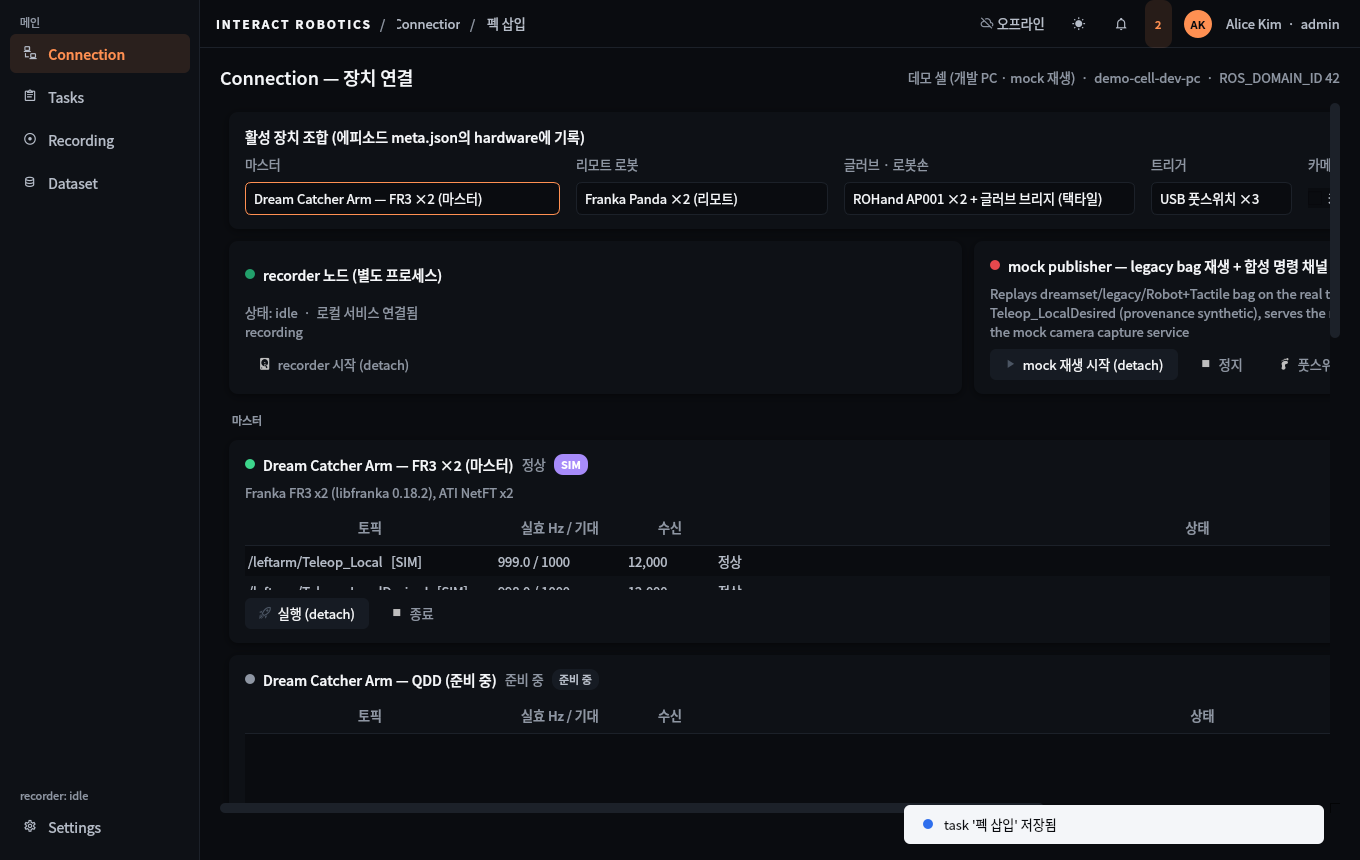
Every device. Every channel. In view.
Check the connection status of the master, remote robot, and sensors, then choose the configuration your task needs.
Originals stay where the work happens.
Record to the local PC first, preserving original timestamps. Align and export data after the original records are safely captured.
Know what you captured. And how.
Keep tasks, operators, device configurations, and channel sources together. Identify missing or anomalous signals and connect review results to the data.
A clear path from capture to learning.
Export selected episodes in a configuration for learning. Available channels depend on the connected devices and the project.
Explore Dream Set data →Movement meets force.
In one control engine.
Stable bilateral control. Clear force transmission and high-stiffness rendering. Compensation that reduces device resistance. Lucid brings these research algorithms into one system control layer.
Concept diagram. Lucid handles control; Studio handles acquisition. The control loop is kept separate from recording and review.
A real task. A shared starting point.
Tell us about the contact task and the collaboration you have in mind, from a consortium to an integrated solution. We’ll review the fit and discuss a demonstration of our current systems.